


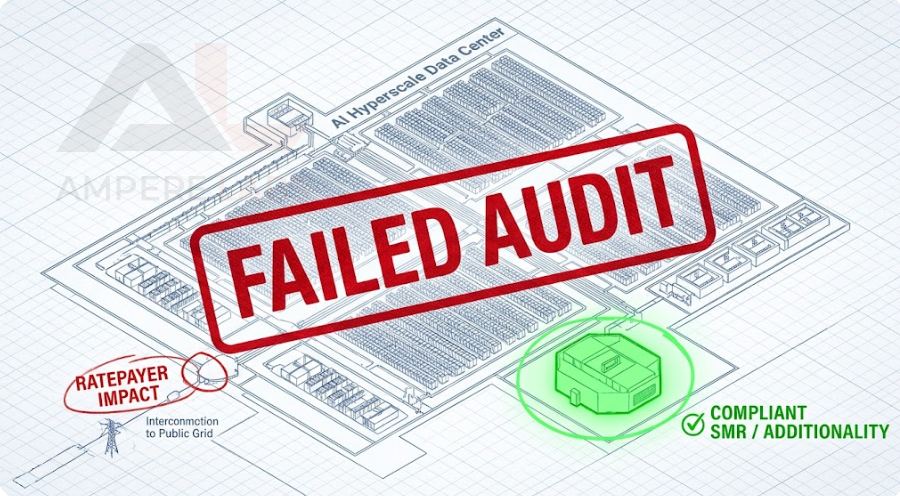
The era of unrestricted "grid-grabbing" for AI data centers has officially come to an end. While the industry is currently witnessing a historic $25.2 billion-per-month construction boom, a new federal regulatory landscape is fundamentally decoupling AI growth from the public power grid. For infrastructure developers, investors, and hyperscalers, the "Ratepayer Protection Pledge" introduced on March 4th represents a paradigm shift that will determine which projects survive the second half of 2026.
The Shift from Innovation to Energy Accountability
The scale of AI infrastructure development has reached a tipping point where it is no longer just a technological trend, but a significant political and economic liability. In key hubs like Northern Virginia, electricity prices have surged nearly 30% over the last several years as data center demand competes with residential and essential public services.
The federal response—the Ratepayer Protection Pledge—aims to ensure that the massive energy appetite of Big Tech does not result in higher monthly bills for the average household. If an infrastructure project cannot demonstrate "Ratepayer Neutrality," it is increasingly unlikely to receive the necessary permits for operation.
The Five Pillars of the Ratepayer Protection Pledge
On March 4th, 2026, seven industry leaders—including Amazon, Google, Microsoft, and OpenAI—committed to a framework that establishes five core pillars for future development:
- Additionality (Build, Bring, or Buy): Signatories must ensure net-new power is added to the grid. Projects can no longer simply outbid local institutions for existing capacity; they must build new generation, bring their own, or buy dedicated new sources.
- Infrastructure Funding: The "socialization" of transmission and distribution costs is over. Companies are now expected to pay the full cost of the upgrades required to support their facilities.
- Bespoke Rate Structures: Moving toward "Take-or-Pay" tariffs, where operators pay for reserved capacity regardless of actual usage, ensuring utilities are compensated for the infrastructure they maintain.
- Workforce Investment: A mandate for direct local hiring and training programs within host communities.
- Grid Resilience: On-site backup power, such as large-scale battery storage or Small Modular Reactors (SMRs), must be made available to the public grid during energy emergencies.
From Voluntary Pledges to Federal Law
While the initial March 4th pledge was voluntary, the National Policy Framework for AI released on March 20th signals a move toward codifying these protections into federal law. The framework suggests that while the federal government may preempt certain state laws to maintain AI dominance, it will not shield developers from local energy audits or zoning restrictions.
This creates a significant bottleneck. Utilities are already beginning to prioritize interconnection for projects that align with "Ratepayer Neutrality," leaving those without a clear energy strategy at the back of an increasingly long line.
The Strategic Pivot: Protected Power and Modular Solutions
The competitive landscape of the AI race is shifting from "who has the most GPUs" to "who has the most protected power." To navigate these new constraints, the industry is seeing a rapid pivot toward behind-the-meter and modular infrastructure solutions.
By utilizing "stranded energy"—power sources not connected to the public transmission lines—agile operators can effectively bypass the "Ratepayer Protection" audits that are currently stalling large-scale hyperscale projects. Those who can "bring" their own power through modular, decentralized designs will be the ones who successfully scale inference markets through 2027.