


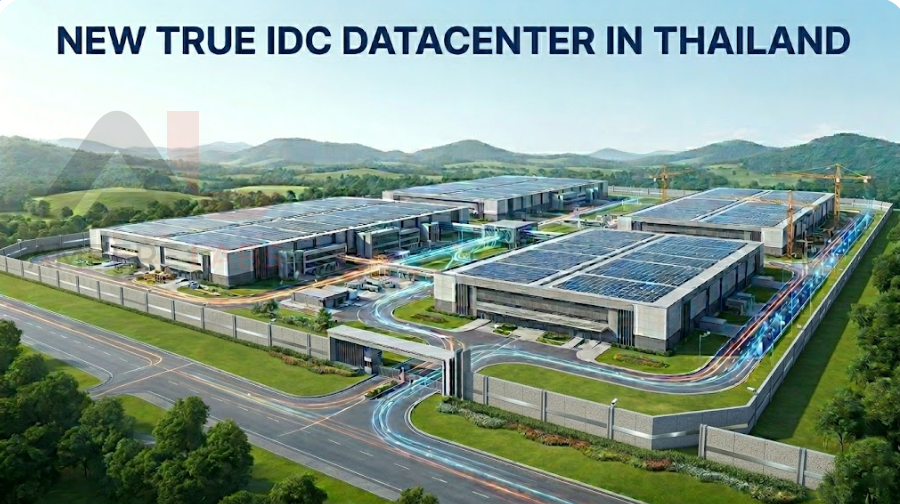
For the past decade, the evolution of the cloud was dictated by a single metric: efficiency. The industry goal was to centralize data wherever power was cheapest and latency was lowest. However, the recent $2.1 billion (77 billion THB) project breaking ground in Thailand marks a fundamental pivot in the global landscape. We have officially entered the era of the Security Economy.
At Ampere Labs, we monitor these infrastructure shifts closely. As we transition from a "Global Cloud" to a "Sovereign Cloud" model, the technical requirements for AI and High-Performance Computing (HPC) are being rewritten. This isn't just a regional update; it is a roadmap for the future of digital independence.
The $2.1 Billion Sovereign Blueprint
On April 1, 2026, True IDC announced a massive expansion in Thailand’s Eastern Economic Corridor (EEC), backed by partnerships with Global Infrastructure Partners (GIP) and BlackRock. This isn’t merely another data center expansion—it is a 250-megawatt hyperscale facility specifically engineered for Data Sovereignty.
The "Security Economy," a term introduced by True IDC President Thanasorn Jaidee, describes a world where national governments are no longer content to host critical AI models in a generic, borderless cloud. They are demanding that "AI brains" live within their own borders, protected by both physical and digital "passports".
The Technical Challenge: Scale,Modularity, and Cooling
From an infrastructure perspective, the Thailand project highlights three critical requirements for the next generation of AI facilities:
- Modular Architecture: True IDC is utilizing modular designs to deploy "Sovereign Pods". This allows for isolated, specialized AI zones that can scale independently while maintaining strict security perimeters.
- High-Density Power: With a 250 MW capacity, the facility is built to handle the staggering power draws of modern GPU clusters.
- Advanced Cooling: These sovereign pods run incredibly hot. To support the most advanced GPU workloads, the transition to Direct Liquid Cooling (DLC) and advanced thermal management is no longer optional, but a prerequisite.
Our experience leading AI/HPC infrastructure initiatives has shown that the "fatal flaw" in many existing strategies is optimizing for yesterday’s latency needs while ignoring tomorrow’s sovereignty requirements. While Big Tech giants like Microsoft are now committing billions to "catch up" in regions like Thailand, the real advantage lies with those who can build for security and scale locally.
Navigating the New Frontier
The shift toward the Security Economy creates a new breed of requirements for enterprises and governments alike. It requires a deep understanding of the intersection between High-Performance Computing and national security regulations.
As we continue to develop Ampere Labs, our goal is to leverage our background in modular data center design and HPC infrastructure to help partners navigate this transition. The "Old Cloud" skills are quickly becoming a commodity; the future belongs to those who can build the physical and legal vaults that will house the world’s AI.
The era of efficiency-first is over. The era of sovereignty-first has begun.